


In the world of stone processing, the 5 Axis Bridge Saw stands as a remarkable innovation, offering unparalleled precision and versatility in cutting various types of stones. As a leading supplier of 5 Axis Bridge Saws, I am often asked about how these machines achieve 5 - axis movement. In this blog post, I will delve into the technical details and mechanisms that enable a 5 Axis Bridge Saw to perform its complex and precise operations.
Understanding the Basics of 5 - Axis Movement
Before we explore how a 5 Axis Bridge Saw achieves 5 - axis movement, it's essential to understand what 5 - axis movement means. In a 5 Axis Bridge Saw, the five axes refer to three linear axes (X, Y, and Z) and two rotational axes (A and C). The linear axes allow the saw to move in a straight line along the length (X - axis), width (Y - axis), and height (Z - axis) of the working area. The rotational axes, on the other hand, enable the saw blade to tilt (A - axis) and rotate (C - axis), providing the ability to cut at various angles and create complex shapes.
The Linear Axes: X, Y, and Z
The X, Y, and Z axes are the foundation of the 5 Axis Bridge Saw's movement. These axes are typically driven by high - precision linear guides and ball screws.
X - Axis Movement
The X - axis is responsible for the movement of the bridge along the length of the working table. A powerful servo motor is connected to a ball screw, which converts the rotational motion of the motor into linear motion. As the motor rotates, the ball screw moves the bridge along the linear guides, allowing the saw to travel smoothly and accurately along the X - axis. This movement is crucial for making long, straight cuts on large stone slabs.
Y - Axis Movement
The Y - axis controls the movement of the cutting head along the width of the working table. Similar to the X - axis, a servo motor and ball screw system are used to drive the cutting head along the linear guides. The Y - axis movement enables the saw to make cross - cuts and position the blade precisely on the stone slab.
Z - Axis Movement
The Z - axis is responsible for the vertical movement of the cutting head. This axis allows the saw blade to move up and down, controlling the depth of the cut. A servo motor and ball screw mechanism are also used for the Z - axis movement. The ability to adjust the Z - axis precisely is essential for achieving accurate cutting depths, especially when working with different thicknesses of stone.
The Rotational Axes: A and C
The A and C axes are what set the 5 Axis Bridge Saw apart from traditional saws, allowing for complex and angled cuts.
A - Axis Movement
The A - axis enables the saw blade to tilt. This is achieved through a specialized rotary actuator or a servo - driven gear system. The actuator or gear system is designed to rotate the saw blade around a horizontal axis, allowing it to cut at different angles. For example, when cutting bevels or chamfers on the edges of a stone slab, the A - axis movement is crucial. The A - axis can typically rotate the saw blade up to 45 degrees or more, depending on the design of the machine.
C - Axis Movement
The C - axis allows the saw blade to rotate around a vertical axis. Similar to the A - axis, a servo - driven mechanism is used to control the rotation of the saw blade. The C - axis movement is essential for making circular cuts, arcs, and other curved shapes. By combining the C - axis movement with the linear and A - axis movements, the 5 Axis Bridge Saw can create highly complex and precise stone shapes.
The Control System
The control system of a 5 Axis Bridge Saw is the brain that coordinates all the axes' movements. Modern 5 Axis Bridge Saws are equipped with advanced CNC (Computer Numerical Control) systems. These systems use software to convert design files into machine - readable instructions.
The CNC system receives input from the operator, who can program the desired cutting path, angles, and depths. The system then calculates the necessary movements for each axis and sends signals to the servo motors to execute the programmed operations. The control system also monitors the position and movement of each axis in real - time, ensuring high accuracy and repeatability.
Safety and Precision Features
To ensure the safety and precision of the 5 Axis Bridge Saw, several features are incorporated into the design.
Limit Switches
Limit switches are installed at the end of each axis to prevent the machine from moving beyond its safe operating range. When the saw reaches the limit of an axis, the limit switch sends a signal to the control system, which stops the movement of the axis to avoid damage to the machine.
Encoders
Encoders are used to provide feedback on the position and movement of each axis. They measure the rotation of the servo motors and ball screws and send this information back to the control system. The control system uses this feedback to adjust the movement of the axes and ensure accurate positioning.
Anti - Collision Sensors
Anti - collision sensors are installed on the cutting head and other moving parts of the machine. These sensors detect any potential collisions with the stone slab or other objects in the working area. If a collision is detected, the control system immediately stops the movement of the machine to prevent damage.
Applications of 5 Axis Bridge Saws
The ability of 5 Axis Bridge Saws to achieve 5 - axis movement makes them suitable for a wide range of applications in the stone processing industry.
Countertop Fabrication
In countertop fabrication, 5 Axis Bridge Saws are used to cut and shape granite, marble, and quartz countertops. The machine can create precise cutouts for sinks, cooktops, and other fixtures, as well as beveled and rounded edges.

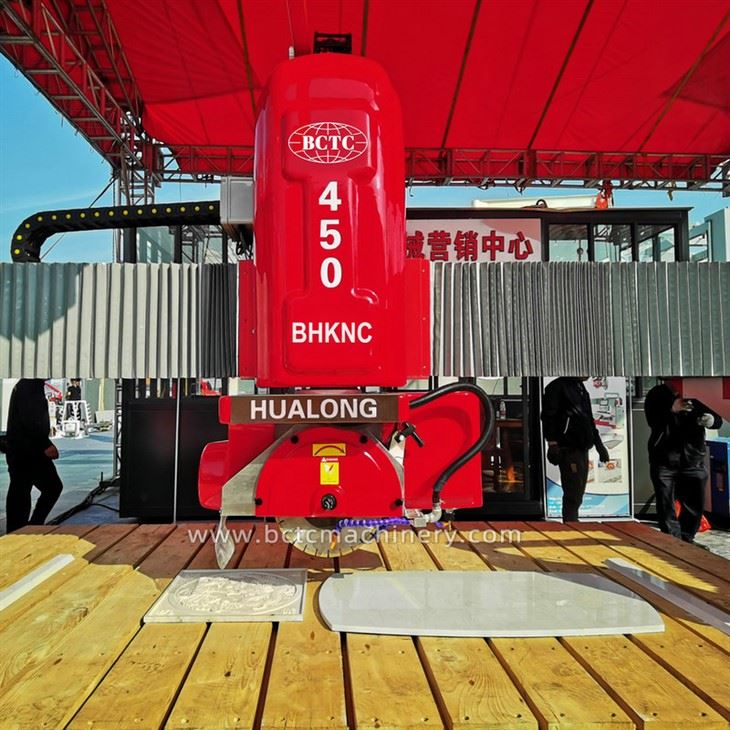
Architectural Stonework
For architectural stonework, 5 Axis Bridge Saws can be used to create complex shapes and designs for building facades, columns, and decorative elements. The ability to make angled and curved cuts allows for the creation of unique and intricate stone structures.
Monument and Memorial Production
In the monument and memorial industry, 5 Axis Bridge Saws are used to cut and engrave headstones, plaques, and other memorial pieces. The machine can create detailed lettering, designs, and sculptures on the stone surface with high precision.
Our Company's 5 Axis Bridge Saws
As a supplier of 5 Axis Bridge Saws, we take pride in offering high - quality machines that are designed to meet the needs of our customers. Our 5 Axis Bridge Saws are equipped with the latest technology and features, ensuring reliable performance and excellent cutting results.
We offer a range of models to suit different production requirements and budgets. Whether you are a small - scale stone fabricator or a large - scale industrial manufacturer, we have a 5 Axis Bridge Saw that is right for you. Our machines are also backed by a team of experienced technicians who can provide installation, training, and after - sales support.
If you are interested in learning more about our Bridge Saw Cutting Machine, Bridge Saw Granite, or Monoblock Bridge Saw, or if you have any questions about how a 5 Axis Bridge Saw can benefit your business, please do not hesitate to contact us. We are here to help you find the best solution for your stone processing needs.
Conclusion
The 5 Axis Bridge Saw is a remarkable piece of machinery that combines advanced technology and engineering to achieve 5 - axis movement. By understanding the mechanisms behind the linear and rotational axes, as well as the role of the control system and safety features, we can appreciate the precision and versatility of these machines. Whether you are in the countertop fabrication, architectural stonework, or monument production industry, a 5 Axis Bridge Saw can significantly improve your productivity and the quality of your products.
If you are considering investing in a 5 Axis Bridge Saw, we encourage you to contact us for more information. Our team of experts will be happy to discuss your specific requirements and help you choose the right machine for your business.
References
- "Stone Cutting Machinery Handbook", Stone Industry Press
- "CNC Machining Technology", Manufacturing Technology Publishing House
- Technical documents from leading 5 Axis Bridge Saw manufacturers