


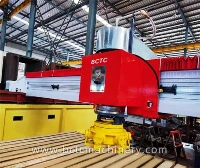
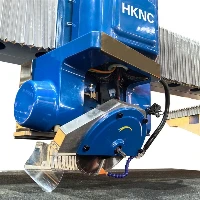
The core value of CNC stone processing equipment lies not merely in the sophistication of its technical specifications, but in its practical ability to facilitate routine production while enhancing efficiency and reducing costs. Only when the 5-axis bridge saw's capability for multi-dimensional processing of curved and complex shapes shifts from a niche, ad-hoc customization method to a standard practice for daily mass production can the equipment fully unlock its value and generate stable, substantial returns for the enterprise.
Drawing on production scenarios across the entire stone industry value chain, this article focuses on high-yield applications for 5-axis bridge saws. By comparing the processing capabilities and suitable product categories of 3-axis, 4-axis, and 5-axis machines-specifically covering home countertops, landscape stone, and architectural custom stone-it provides a precise breakdown of the logic behind selecting the right equipment for different production lines.
I. Stone Countertop Processing: Suited for Mass Production of Custom, Complex Shapes
Standard stone countertop factories primarily produce standardized kitchen and bathroom countertops. Their production processes-such as straight-line cutting and fixed-angle beveling-are straightforward, resulting in uniform styles. For such standardized mass-production scenarios, traditional 3-axis or 4-axis bridge saws fully meet production needs; their cost-effectiveness and operational efficiency are well-suited to routine orders, making investment in high-end 5-axis equipment unnecessary.
However, for stone factories specializing in high-end customization and complex countertop shapes, the advantages of 5-axis bridge saws are fully realized. Daily operations often involve complex tasks such as edge profiling for curved countertops, precision cutouts for irregular sinks, 3D cutting for waterfall-style islands, and shaping personalized stone furniture. These multi-dimensional, complex, and three-dimensional processing requirements represent the technical limitations of 3-axis and 4-axis machines.
Leveraging 5-axis simultaneous CNC technology, 5-axis bridge saws enable multi-dimensional shaping with a single setup, eliminating the need for repeated positioning or secondary grinding. This ensures precise machining accuracy for complex workpieces while significantly simplifying production workflows and shortening processing cycles. They perfectly meet the demand for batch production of custom countertops, effectively addressing industry pain points such as overly complex processes, low yield rates, and insufficient production capacity.
II. Landscape Stone Processing: Prioritizing Stable, High-Volume Production
The production logic for landscape stone differs significantly from that of custom countertops; it is characterized primarily by standardization, batch processing, and repetitive cutting. Mainstream landscape stone products-such as pavers, wall cladding, step stones, curbstones, and coping stones-feature uniform specifications and simple processing requirements. Production relies mainly on straight cuts and standard bevel cuts, requiring almost no complex CNC shaping.
Practical data from numerous partner landscape stone processing plants indicates that these enterprises prioritize long-term operational stability, millimeter-level cutting precision, and equipment durability over multifunctionality. In high-frequency, high-intensity mass production environments, factors such as low failure rates, continuous operational capability, and cutting uniformity are far more critical to boosting overall efficiency and reducing maintenance costs than high-end features like multi-axis simultaneous motion; they are the keys to ensuring long-term production capacity.
III. Architectural Custom Stone: Scenarios Requiring 5-Axis Processing
Architectural stone and high-end custom stone projects represent the ideal application for 5-axis bridge saws and constitute a core competitive advantage for high-end stone processors. These applications move entirely beyond standardized cutting, focusing instead on decorative, complex-shaped, personalized, and artistic processing requirements.
Specific products include architectural facade components, curved stone elements, stones with irregular geometric shapes, artistic carved stone, and custom curtain wall panels. These workpieces often feature complex curvatures, irregular forms, significant dimensional variations, and strict precision requirements. They demand multi-angle, multi-dimensional 3D cutting, openwork (piercing), and edge finishing. Traditional 3-axis and 4-axis machines-limited by their axis linkage capabilities-cannot handle this processing in a single integrated workflow. Relying on manual secondary shaping and assembly not only makes it difficult to meet precision standards but also severely compromises production efficiency and the final product's aesthetic quality.
Leveraging its comprehensive, multi-axis, and multi-dimensional coordinated machining capabilities, the five-axis bridge saw enables the precision, integrated shaping of complex curved surfaces, uniquely shaped components, and irregular stone pieces without the need for rework. This technology not only meets the rigorous craftsmanship standards and aesthetic requirements of high-end architectural stone but also significantly boosts delivery capabilities for custom projects, empowering enterprises to secure high-end contracts and establish a competitive edge through differentiation.