





Marble Block Cutting Solutions and Practices with Ultra-Thin Multi Wire Saw Machines

Three Ultra-Thin Multi Wire Saw Machine Solutions for Marble Block Cutting
Marble blocks are generally characterized by their large volume and heavy weight. The core requirements for cutting marble slabs clearly point to three key aspects: high output rate, precise thickness control, and low surface damage. The core differences between different types of marble are concentrated in key dimensions such as brittleness, texture structure, and impurity content. The cutting process must be fully adapted to the high load and large cutting volume characteristics of block cutting. This requires targeted optimization and adjustment of diamond wire selection, process parameter settings, and auxiliary system configuration to ensure that both cutting efficiency and slab quality meet the standards.
The following are customized cutting solutions for different types of marble blocks, compiled from practical experience to form a best practice guide:
1. Highly Brittle Light-Colored Marble Blocks (Representative Varieties: Caracata, Snowflake White, Carrara White)
Core Cutting Challenges:
This type of marble is extremely brittle, with a bending strength ≤8MPa. The internal stress distribution of the block is uneven, making it highly susceptible to edge-penetrating and grain-direction cracking defects during slab cutting. Furthermore, the surface of light-colored slabs is extremely sensitive to scratches from impurities in the blank, and the finished product requires a gloss level of ≥90GU.
Customized Cutting Solution:
Diamond Wire Selection: 0.5-0.6mm high-strength electroplated diamond wire is selected, with an abrasive grain size controlled at 50-60 mesh. The base material is high-carbon steel wire with a breaking strength ≥2800MPa, fully meeting the high tensile and high load-bearing requirements of cutting the block slabs. Simultaneously, the abrasive grain shedding rate of the electroplating layer is strictly controlled to ≤8%, preventing scratches and defects on the slab surface from the source.
Process Parameter Settings (Suitable for slab thicknesses of 30-80mm):
Linear Speed: 6-10m/s, employing a low-speed, stable cutting mode to minimize the impact of wire saw vibration on the marble texture, and strictly controlling the vibration amplitude to ≤0.02mm to ensure slab flatness meets standards;
Feed Speed: Employing a segmented, precise control strategy-Initial stage (0-5mm): 0.1-0.2mm/min, releasing surface stress on the raw material through slow cutting to prevent edge chipping; Mid-stage (5mm to 80% of raw material thickness): 0.4-0.6mm/min, achieving a balance between cutting efficiency and slab quality; Final stage (remaining 20%): 0.2-0.3mm/min, effectively preventing bottom edge chipping and corner cracking;
Tension Control: Set to 25-30N, adapting to the cutting load of the raw material, avoiding excessive tension that could cause internal texture cracking in the slab, while ensuring no slippage of the diamond wire, guaranteeing uniform slab thickness.
Auxiliary Protective Measures (Focusing on Ensuring Finished Sheet Quality):
Cutting Fluid: A composite formula of low-temperature water-based cutting fluid, anti-whitening agent, and corrosion inhibitor is used, with the cutting fluid temperature controlled ≤38℃. Multi-point atomization spraying is achieved through 8-10 nozzles, with a spraying pressure of 0.6-0.8MPa and droplet size controlled at 10-15μm, fully covering the cutting area. This effectively cools the diamond wire and cutting surface, quickly removes chips, and prevents watermarks on the sheet surface.
Blank Fixing: A fixing method combining vacuum adsorption, rigid pressure beams, and 10mm thick polyurethane pads is used. The pressure beam pressure is adjusted to 0.3-0.5MPa to effectively prevent blank displacement and avoid deviations in sheet thickness.
Chip Removal System: Equipped with a ring-shaped negative pressure suction port (negative pressure value -0.06MPa), coupled with a 10μm precision secondary filter, it can quickly remove dust and grit particles generated during cutting, fundamentally preventing scratches on the sheet surface.

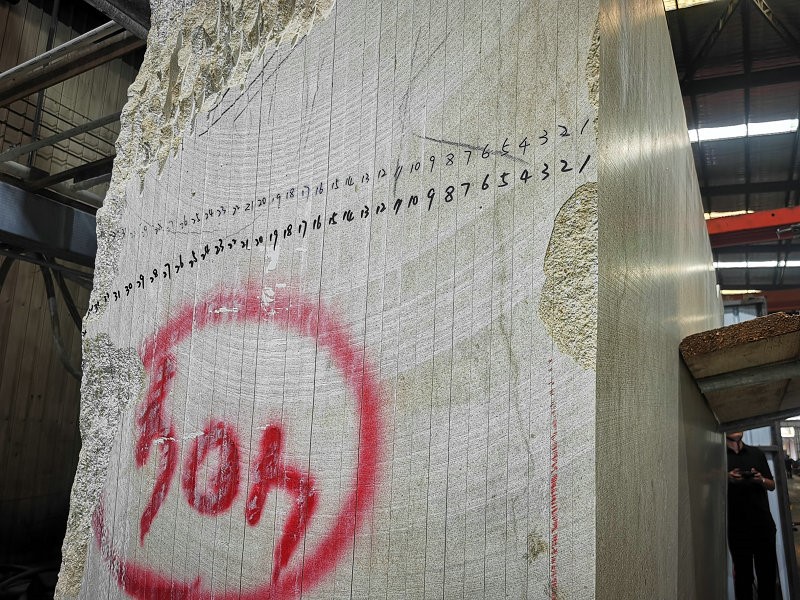
2. Marble Blocks Containing Hard Crystals (Representative Varieties: Jazz White, Carrara White, Grey Vein Marble)
Core Cutting Challenges:
These blocks contain a large number of quartz crystals with a Mohs hardness of 7, causing a sudden increase in local cutting resistance of over 30%, easily leading to diamond wire dulling and breakage. Simultaneously, the soft substrate surrounding the crystals is prone to cracking, severely affecting the integrity of the slab. Furthermore, the large size of the blocks makes them susceptible to thickness deviations due to wire saw offset during cutting, affecting the precision of the finished product.
Customized Cutting Solution:
Diamond Wire Selection: 0.6-0.7mm resin-bonded diamond wire with an abrasive grain size of 40-50 mesh is used. The resin bond provides excellent self-sharpening properties, and the multi-layer spiral abrasive grain arrangement design increases the abrasive grain density by 50% compared to ordinary wire saws, significantly improving hard-spot cutting efficiency, adapting to the high-load cutting requirements of blocks, and ensuring continuous and stable cutting of slabs.
Process Parameter Settings (Suitable for sheet thicknesses of 50-100mm):
Linear Speed: 8-12m/s. Increasing the linear speed reduces localized compression of the abrasive grains by the crystals, extending the lifespan of the diamond wire and ensuring a smooth and flat cut surface.
Feed Rate: Employs a closed-loop cutting force control mode, setting the force threshold to 30-35N. When the cutting force exceeds 35N (i.e., contacting dense crystalline regions), the feed rate automatically decreases by 0.1-0.2mm/min (e.g., from 0.5mm/min to 0.3mm/min). When the cutting force is below 30N, the feed rate automatically increases, effectively preventing sheet chipping or diamond wire breakage due to overload.
Tension Control: Set to 30-35N, employing a dynamic tension compensation strategy. Automatically applies 1.5N tension compensation when encountering crystalline regions to prevent wire saw sagging, ensuring straightness of the sheet cut and strictly controlling thickness deviation within ±0.1mm.
Auxiliary Protective Measures (Focusing on Ensuring Sheet Precision and Integrity):
Cutting Fluid: Adding extreme pressure anti-wear agents (such as phosphate esters) can reduce the coefficient of friction between the crystal and diamond wire by 20%, reducing cutting resistance; simultaneously, increasing the cutting fluid flow rate to 30-40 liters/minute enhances chip removal, prevents crystal dust from clogging the abrasive grains, and avoids scratches on the sheet surface;
Equipment Calibration: Before cutting, a laser positioning instrument is used to calibrate the parallelism of the guide wheel assembly, ensuring an error ≤0.015mm/m; simultaneously, a level is used to calibrate the placement position of the raw material, controlling the horizontal error ≤0.1mm/m, ensuring uniform sheet thickness from the source.
3. Loose-textured marble blocks (Representative varieties: Beige marble, Golden Beige marble, Light Brown Reticulated Marble)
Core Cutting Challenges:
This type of marble has a loose structure with a porosity ≥3%. When cut into slabs, it is prone to large-area texture loss and edge chipping, leading to a high scrap rate. Simultaneously, the large surface area of the raw stone allows cutting fluid to seep in, causing color variations in the slab. The cut surface is also prone to roughness, directly affecting the gloss of subsequent processing and increasing processing costs.
Customized Cutting Solution
Diamond wire selection: 0.55-0.6mm electroplated diamond wire with a 50-60 mesh abrasive grain size and uniform distribution is used. Nickel alloy plating enhances the wire's rigidity, achieving a tensile strength ≥2600MPa. This effectively reduces tearing of loose particles, adapts to the vibration environment of raw stone cutting, and maximizes the integrity of the slab.
Process Parameter Settings (Suitable for sheet thicknesses of 40-90mm):
Linear Speed: 10-14m/s, employing high-speed cutting mode to shorten the contact time between the diamond wire and the loose texture, reducing texture detachment and edge chipping;
Feed Speed: 0.5-0.7mm/min, maintaining a stable feed to avoid uneven stress in localized textured areas due to speed fluctuations, further reducing the risk of edge chipping;
Tension Control: Set to 32-36N, achieving "rapid cutting" of the raw stone with the diamond wire through high tension, reducing friction and detachment between the texture and the wire, while ensuring stable wire saw operation and guaranteeing sheet flatness.
Auxiliary Protective Measures (Focusing on Protecting Texture Integrity and Avoiding Color Difference):
Cutting Fluid: Add waterproof sealant (such as silane coupling agent) to reduce liquid absorption on the slab surface, effectively preventing color differences; use low-pressure, large-area spraying, with a spraying pressure of 0.4-0.6MPa and a spraying area ≥0.8m², to prevent loose texture loss and slab damage caused by high-pressure spraying;
Slab Post-treatment: Immediately after cutting, apply a raw stone-specific sealant matching the stone color to the entire surface of the slab to seal the stone pores, preventing further texture loss during subsequent transportation and processing. This also increases the basic gloss of the cut surface by 5-8GU, laying a good foundation for subsequent polishing.