


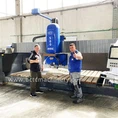
Hey there! As a supplier of 3D stone engraving machines, I often get asked about the engraving speed for 3D lettering. It's a crucial factor, especially for those who want to balance quality and efficiency in their stone - carving projects. So, let's dive right into it.
Understanding Engraving Speed Basics
First off, what exactly is engraving speed? In simple terms, it's how fast the engraving machine moves across the stone surface while creating the 3D lettering. This speed is usually measured in millimeters per minute (mm/min). A higher speed means the machine can complete the engraving job quicker, but it might also compromise the quality of the lettering. On the flip side, a slower speed generally results in more precise and detailed lettering, but it takes longer.
Factors Affecting Engraving Speed for 3D Lettering
Stone Material
Different stones have different hardness levels and compositions, which significantly impact the engraving speed. For example, granite is one of the hardest natural stones. Engraving 3D lettering on Cnc Granite Engraving Machine usually requires a slower speed because the hard surface makes it more difficult for the engraving tool to cut through. If you try to engrave too fast on granite, the tool may wear out quickly, and the quality of the lettering can suffer.
Marble, on the other hand, is relatively softer than granite. With a Cnc Marble Engraving Machine, you can often achieve a faster engraving speed for 3D lettering. The softer nature of marble allows the engraving tool to cut through more easily, reducing the wear on the tool and enabling a quicker production process.
Complexity of the Lettering
The design of the 3D lettering also plays a big role in the engraving speed. Simple, block - style letters can be engraved much faster than highly detailed, cursive letters. Intricate designs with lots of curves, loops, and fine details require the engraving machine to move more precisely, which slows down the overall speed. For instance, a basic "ABC" in a bold font can be engraved at a relatively high speed. But if you want to engrave a fancy, calligraphic script, the machine has to make more delicate and controlled movements, thus reducing the speed.
Engraving Depth
The depth of the 3D lettering is another key factor. Deeper engraving takes more time because the machine has to remove more material from the stone surface. If you're only looking for a shallow engraving, say just a few millimeters deep, the engraving speed can be much higher. However, if you need a deep, prominent engraving, the process will be slower as the machine has to work layer by layer to achieve the desired depth.
Typical Engraving Speeds for Different Scenarios
Low - Complexity Lettering on Soft Stone
When engraving simple 3D lettering on a soft stone like marble, you can expect an engraving speed of around 300 - 600 mm/min. This speed allows for a good balance between getting the job done relatively quickly and maintaining a decent level of quality. For example, if you're engraving basic names or numbers on a marble plaque, this speed range should work well.
High - Complexity Lettering on Hard Stone
For highly detailed 3D lettering on a hard stone such as granite, the speed can drop to as low as 100 - 200 mm/min. This slow speed is necessary to ensure that the intricate details of the lettering are accurately reproduced on the hard surface. If you're engraving a long, elaborate quote in a fancy font on a granite monument, this slower speed will be required.
Importance of Optimizing Engraving Speed
Optimizing the engraving speed is crucial for several reasons. First of all, it affects your productivity. If you can find the right speed that allows you to complete projects as quickly as possible without sacrificing quality, you can take on more jobs and increase your revenue.
Secondly, it impacts the cost of production. Using a machine at an improper speed can lead to premature wear and tear of the engraving tools, which means you'll have to replace them more frequently. This increases the overall cost of production. By finding the optimal speed, you can extend the lifespan of your tools and save money in the long run.
Using Advanced Machines for Better Speed Control
At our company, we offer advanced 3D stone engraving machines, including the Kuka Robot Stone Machine. These machines come with state - of - the - art technology that allows for precise control of the engraving speed. You can adjust the speed according to the specific requirements of each project, ensuring that you get the best results every time.
Our machines are also equipped with intelligent systems that can automatically adjust the speed based on the material and the design of the lettering. This not only saves you time but also ensures a consistent and high - quality output.
Conclusion
So, there you have it! The engraving speed for 3D lettering depends on various factors such as the stone material, the complexity of the lettering, and the engraving depth. By understanding these factors and optimizing the speed, you can achieve a perfect balance between quality and efficiency in your stone - engraving projects.
If you're in the market for a reliable 3D stone engraving machine, we're here to help. Whether you need a machine for simple or complex 3D lettering jobs, we have the right solutions for you. Don't hesitate to reach out to us for more information and to discuss your specific needs. We look forward to working with you to take your stone - engraving business to the next level.


References
- Stone Engraving Technology Handbook
- Industry Reports on 3D Stone Engraving Machines