


Hey there! As a supplier of 5 Axis Bridge Saws, I often get asked about how to measure the cutting accuracy of these bad boys. It's a crucial aspect, especially when you're dealing with high - end stone cutting jobs like those for Granite Bridge Saw Machine or Marble Bridge Cutting Machine applications. So, let's dive right in and break down the steps to measure the cutting accuracy of a 5 Axis Bridge Saw.
Understanding the Basics
First off, we need to know what cutting accuracy means in the context of a 5 Axis Bridge Saw. Cutting accuracy refers to how closely the saw cuts the material according to the pre - programmed dimensions and angles. In a 5 Axis Bridge Saw, we have movement in five different directions (X, Y, Z linear axes and two rotational axes), which allows for complex and precise cuts. But with more axes comes more potential for errors.
Initial Setup and Calibration
Before you can even start measuring the cutting accuracy, you've got to make sure your saw is properly set up and calibrated. This includes checking the alignment of all the axes. The linear axes (X, Y, Z) should be perfectly straight and perpendicular to each other. You can use precision measuring tools like laser alignment systems to ensure this.

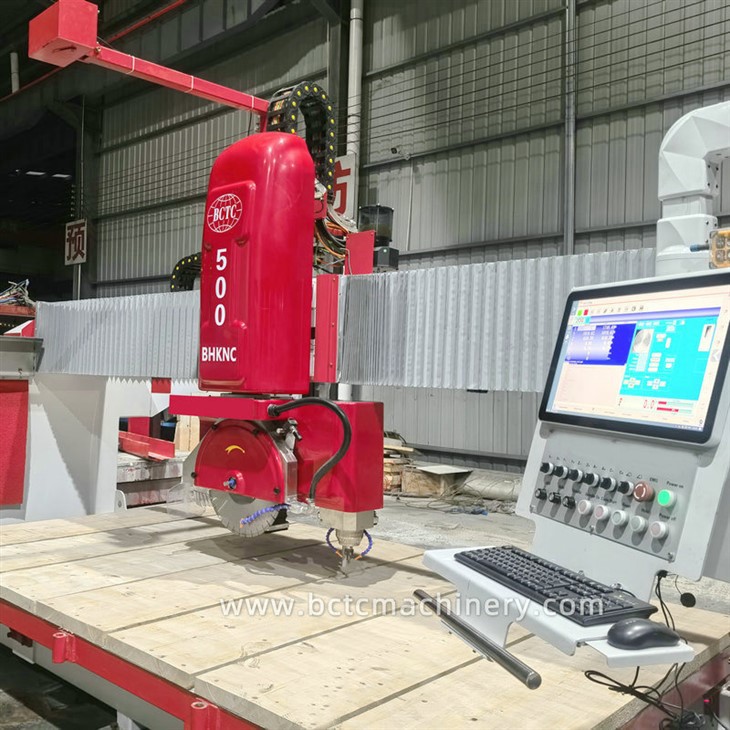
For the rotational axes, make sure they rotate smoothly and accurately to the programmed angles. Any looseness or misalignment in these axes can lead to significant errors in the final cut. Also, check the blade installation. A blade that's not properly installed can cause vibrations, which will affect the cutting accuracy.
Measuring Linear Accuracy
Let's start with the linear axes. One of the most common ways to measure the linear accuracy of the X, Y, and Z axes is by using a precision measuring device like a linear encoder or a laser interferometer.
A linear encoder is a device that measures the linear displacement of an object. You can attach it to the moving part of the saw's axis and compare the actual movement with the programmed movement. For example, if you program the saw to move the X - axis 100 mm, the linear encoder will tell you how close the actual movement is to that 100 mm.
A laser interferometer is even more accurate. It uses the interference of laser light to measure the distance with extremely high precision. It can detect even the slightest deviations in the movement of the axis. You set up the laser interferometer according to the manufacturer's instructions and then run a series of test cuts with different linear displacements. Compare the results from the interferometer with the programmed values to determine the linear accuracy.
Measuring Angular Accuracy
The rotational axes in a 5 Axis Bridge Saw are just as important as the linear axes. To measure the angular accuracy, you can use a precision angle measuring device like a digital protractor or a rotary encoder.
A digital protractor can be used to measure the angle of the cut directly on the workpiece. After making a cut at a specific programmed angle, use the digital protractor to measure the actual angle of the cut. Compare this value with the programmed angle to see how accurate the saw is in terms of angular cuts.
A rotary encoder, on the other hand, is attached to the rotational axis of the saw. It measures the angular displacement of the axis and can provide real - time feedback on the actual rotation compared to the programmed rotation. Similar to the linear encoder, you can run a series of test cuts with different angular settings and analyze the data from the rotary encoder.
Measuring Cutting Tolerance
Cutting tolerance is another important aspect of cutting accuracy. It refers to the acceptable range of deviation from the programmed dimensions. For example, if you program a cut with a width of 50 mm, the cutting tolerance might be set at ±0.1 mm. This means that the actual width of the cut can be anywhere between 49.9 mm and 50.1 mm and still be considered within the acceptable range.
To measure the cutting tolerance, you need to make a series of test cuts and measure the dimensions of the cuts using precision measuring tools like calipers or micrometers. Compare the measured dimensions with the programmed dimensions and calculate the deviation. If the deviation is within the specified cutting tolerance, then the saw is considered to be cutting accurately.
Using Test Pieces
One of the best ways to comprehensively measure the cutting accuracy of a 5 Axis Bridge Saw is by using test pieces. You can design a test piece with a variety of different cuts, including linear cuts, angular cuts, and complex 3D cuts.
For example, you could create a test piece with a series of parallel linear cuts at different distances from each other, and then measure the distances between the cuts using a precision measuring tool. You could also include some angular cuts at different angles and measure the angles as described earlier.
After making the cuts on the test piece, carefully measure all the dimensions and angles and compare them with the programmed values. Analyze the data to identify any patterns of errors. For instance, if you notice that all the angular cuts on one side of the test piece are consistently off by a certain amount, it could indicate a problem with the alignment of the rotational axis.
Analyzing the Results
Once you've collected all the data from your measurements, it's time to analyze it. Look for any trends or patterns in the errors. If you find that the errors are consistent across multiple cuts, it could be a sign of a systematic problem, such as a misaligned axis or a worn - out component.
If the errors are random, it could be due to factors like vibrations, blade wear, or electrical interference. Make a note of all the errors and their possible causes. Then, you can take steps to correct these issues, such as realigning the axes, replacing worn - out parts, or improving the electrical grounding of the saw.
Continuous Monitoring and Improvement
Measuring the cutting accuracy of a 5 Axis Bridge Saw isn't a one - time thing. You should regularly monitor the accuracy of the saw to ensure that it continues to perform at its best. Set up a schedule for regular calibration and accuracy checks.
As technology advances, there are also new tools and techniques available for measuring and improving cutting accuracy. For example, some modern 5 Axis Bridge Saws come with built - in monitoring systems that can continuously track the performance of the saw and alert you to any potential issues.
Conclusion
Measuring the cutting accuracy of a 5 Axis Bridge Saw is a complex but essential process. By following the steps outlined above, you can ensure that your saw is cutting as accurately as possible. Whether you're using it for Granite Bridge Saw Machine applications or Marble Bridge Cutting Machine jobs, having a highly accurate saw will result in better quality products and increased customer satisfaction.
If you're in the market for a high - quality 5 Axis Bridge Saw or need more information on how to improve the cutting accuracy of your existing saw, don't hesitate to reach out. We're here to help you make the most of your stone cutting operations. And if you're interested in more advanced CNC solutions for marble, check out our Marble Cnc Machine.
References
- "Precision Machining Technology" by David A. Dornfeld
- "Metrology for Machine Tools" by John R. Clavel