


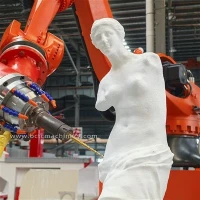


In the realm of stone processing, the CNC Diamond Wire Saw has emerged as a revolutionary tool, offering unparalleled precision and efficiency. As a dedicated supplier of Cnc Diamond Wire Saw, I've witnessed firsthand the transformative impact this technology has on the industry. One of the most critical factors influencing the performance of a CNC diamond wire saw is the wire speed. In this blog post, we'll delve into the intricate relationship between wire speed and cutting efficiency, exploring how optimizing this parameter can significantly enhance productivity and quality in stone cutting operations.


Understanding the Basics of a CNC Diamond Wire Saw
Before we dive into the effects of wire speed, let's first understand the fundamental principles of a CNC diamond wire saw. This advanced machine utilizes a continuous loop of diamond - embedded wire to cut through various types of stone, including granite, marble, and quartz. The wire is driven by a series of pulleys and motors, and its movement is precisely controlled by a computer numerical control (CNC) system. This allows for highly accurate and complex cutting patterns to be achieved with ease.
The cutting action of the diamond wire is based on the abrasive nature of the diamonds embedded in the wire. As the wire moves across the stone surface, the diamonds grind away at the material, gradually creating a kerf. The efficiency of this process depends on several factors, including the quality of the diamond wire, the hardness of the stone, and, most importantly, the wire speed.
Impact of Wire Speed on Cutting Efficiency
Material Removal Rate
The material removal rate (MRR) is a key indicator of cutting efficiency. It refers to the volume of material removed per unit of time. Generally, as the wire speed increases, the MRR also increases. This is because a higher wire speed means that more diamonds on the wire come into contact with the stone surface in a given time frame, leading to more aggressive cutting.
However, there is a limit to this relationship. If the wire speed is too high, the diamonds may not have enough time to effectively penetrate the stone, resulting in reduced cutting efficiency. Additionally, excessive wire speed can cause the wire to overheat, leading to premature wear and breakage. Therefore, it is crucial to find the optimal wire speed that maximizes the MRR without compromising the integrity of the wire.
Surface Finish
Another important aspect of cutting efficiency is the surface finish of the cut stone. A smooth and even surface finish is often desired in stone processing applications, as it reduces the need for additional finishing operations. The wire speed can have a significant impact on the surface finish.
At lower wire speeds, the diamonds on the wire have more time to interact with the stone surface, resulting in a smoother cut. However, this also means that the cutting process is slower. On the other hand, higher wire speeds can lead to a rougher surface finish due to the more aggressive cutting action. To achieve a balance between cutting speed and surface finish, it is necessary to select the appropriate wire speed based on the specific requirements of the project.
Wire Wear and Tear
The wire speed also affects the wear and tear of the diamond wire. Higher wire speeds generally result in faster wear of the diamonds on the wire. This is because the increased friction and impact forces at higher speeds cause the diamonds to break down more quickly.
Excessive wire wear not only reduces the cutting efficiency but also increases the operating costs, as the wire needs to be replaced more frequently. Therefore, it is important to monitor the wire wear closely and adjust the wire speed accordingly to extend the service life of the wire.
Factors to Consider When Determining the Optimal Wire Speed
Stone Hardness
The hardness of the stone is one of the most important factors to consider when determining the optimal wire speed. Harder stones, such as granite, require a lower wire speed to ensure effective cutting and minimize wire wear. Softer stones, like marble, can be cut at higher wire speeds without causing excessive damage to the wire.
Wire Diameter and Quality
The diameter and quality of the diamond wire also play a role in determining the optimal wire speed. Thicker wires can generally withstand higher wire speeds, while thinner wires are more suitable for slower speeds. Additionally, high - quality diamond wires with well - bonded diamonds can operate at higher speeds without significant wear.
Cutting Depth and Width
The cutting depth and width also influence the wire speed. Deeper and wider cuts require a slower wire speed to ensure that the diamonds have enough time to penetrate the stone and remove the material effectively.
Case Studies
To illustrate the importance of wire speed in cutting efficiency, let's take a look at a few case studies.
Case Study 1: Granite Cutting
A stone processing company was using a Cnc Diamond Wire Saw to cut granite blocks. Initially, they were operating the saw at a relatively high wire speed of 30 m/s. While the cutting speed was fast, they noticed that the surface finish of the cut granite was rough, and the wire was wearing out quickly. After consulting with our technical team, they reduced the wire speed to 20 m/s. As a result, the surface finish improved significantly, and the wire life increased by 30%. The overall cutting efficiency also improved, as the reduction in wire replacement time outweighed the slight decrease in cutting speed.
Case Study 2: Marble Cutting
Another customer was using our CNC diamond wire saw to cut marble slabs. They started with a low wire speed of 15 m/s to achieve a smooth surface finish. However, the cutting process was very slow, and they were not able to meet their production targets. By increasing the wire speed to 25 m/s, they were able to increase the material removal rate by 40% without sacrificing too much on the surface finish. With a minor additional polishing operation, they were able to achieve the desired quality while significantly improving productivity.
Conclusion and Call to Action
In conclusion, the wire speed has a profound impact on the cutting efficiency of a CNC diamond wire saw. By understanding the relationship between wire speed, material removal rate, surface finish, and wire wear, and by considering factors such as stone hardness, wire diameter, and cutting depth, operators can optimize the wire speed to achieve the best possible results.
As a leading supplier of Cnc Diamond Wire Saw, we are committed to providing our customers with the highest quality equipment and technical support. If you are looking to enhance the cutting efficiency of your stone processing operations, we invite you to contact us to discuss how our CNC diamond wire saws can meet your specific needs. We also offer a range of related products such as Manual Stone Edge Cutting Machine and Granite Rope Cutting Machine. Let's work together to take your stone cutting business to the next level.
References
- Jain, V. K., & Shaw, M. C. (1999). Machining of advanced materials. Prentice Hall.
- Astakhov, V. P. (2006). Metal cutting mechanics: Theory, modelling, and simulation. CRC Press.
- Trent, E. M., & Wright, P. K. (2000). Metal cutting. Butterworth - Heinemann.