




Can a Monoblock Bridge Saw be used for cutting glass?
As a supplier of Monoblock Bridge Saws, I often encounter inquiries from customers about the versatility of our machines. One common question that comes up is whether a Monoblock Bridge Saw can be used for cutting glass. In this blog post, I will delve into this topic, exploring the technical aspects, limitations, and potential applications of using a Monoblock Bridge Saw for glass cutting.
Understanding the Monoblock Bridge Saw
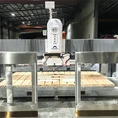
Before we discuss its suitability for glass cutting, let's first understand what a Monoblock Bridge Saw is. A Monoblock Bridge Saw is a type of stone cutting machine that is designed for precision cutting of various types of stones, such as marble, granite, and quartz. It features a rigid bridge structure that spans across the cutting table, providing stability and accuracy during the cutting process. The saw blade is mounted on a carriage that moves along the bridge, allowing for straight and angled cuts.
The main components of a Monoblock Bridge Saw include the bridge, the cutting table, the saw blade, the motor, and the control system. The bridge is typically made of high-quality steel or cast iron, ensuring durability and stability. The cutting table is designed to support the stone workpiece and can be adjusted to different heights and angles. The saw blade is the key component that performs the cutting operation, and it is available in various sizes and types depending on the specific application.
Technical Considerations for Glass Cutting
Glass is a brittle and delicate material that requires special handling and cutting techniques. Unlike stone, glass has a lower density and a different molecular structure, which means that it requires a different approach when it comes to cutting. Here are some technical considerations that need to be taken into account when using a Monoblock Bridge Saw for glass cutting:


Blade Selection
The choice of saw blade is crucial when it comes to cutting glass. A standard stone cutting blade is not suitable for glass cutting because it is designed to cut through hard and abrasive materials, which can cause the glass to crack or shatter. Instead, a diamond blade specifically designed for glass cutting should be used. Diamond blades are made with industrial diamonds embedded in a metal matrix, which provides the necessary cutting edge to slice through the glass without causing damage.
Cutting Speed and Feed Rate
The cutting speed and feed rate are important parameters that need to be carefully controlled when cutting glass. Glass is a brittle material that can easily crack or break if the cutting speed is too high or the feed rate is too fast. Therefore, it is recommended to use a slower cutting speed and a lower feed rate when cutting glass to ensure a smooth and clean cut.
Cooling System
Glass generates a lot of heat during the cutting process, which can cause the glass to crack or warp. Therefore, a cooling system is essential to keep the glass and the saw blade cool during the cutting operation. A water-based cooling system is commonly used for glass cutting, which helps to dissipate the heat and prevent the glass from overheating.
Support and Clamping
Glass is a delicate material that needs to be properly supported and clamped during the cutting process to prevent it from moving or vibrating. A stable cutting table and a secure clamping system are essential to ensure the accuracy and safety of the cutting operation.
Limitations of Using a Monoblock Bridge Saw for Glass Cutting
While a Monoblock Bridge Saw can be used for cutting glass, it does have some limitations. Here are some of the main limitations that need to be considered:
Thickness and Size
A Monoblock Bridge Saw is typically designed for cutting thick and large stone workpieces, which means that it may not be suitable for cutting thin or small glass pieces. The cutting capacity of a Monoblock Bridge Saw is limited by the size of the saw blade and the cutting table, which may not be sufficient for cutting very thin or small glass pieces.
Complex Shapes and Curves
A Monoblock Bridge Saw is mainly designed for straight and angled cuts, which means that it may not be suitable for cutting complex shapes and curves in glass. Cutting complex shapes and curves in glass requires a more advanced cutting technique, such as laser cutting or waterjet cutting, which is not available on a Monoblock Bridge Saw.
Safety Concerns
Glass is a brittle and delicate material that can easily break or shatter, which poses a safety risk to the operator. Therefore, it is important to take appropriate safety precautions when using a Monoblock Bridge Saw for glass cutting, such as wearing protective gear, using a safety shield, and following the manufacturer's instructions.
Potential Applications of Using a Monoblock Bridge Saw for Glass Cutting
Despite its limitations, a Monoblock Bridge Saw can still be used for some applications in glass cutting. Here are some of the potential applications of using a Monoblock Bridge Saw for glass cutting:
Straight Cuts
A Monoblock Bridge Saw is ideal for making straight cuts in glass, such as cutting glass sheets into smaller pieces or cutting glass panels for windows or doors. The precision and accuracy of a Monoblock Bridge Saw make it a suitable tool for making straight cuts in glass.
Angled Cuts
A Monoblock Bridge Saw can also be used for making angled cuts in glass, such as cutting glass for beveled edges or for creating decorative patterns. The adjustable cutting table and the saw blade can be used to make angled cuts in glass with a high degree of accuracy.
Glass Mosaic Tiles
A Monoblock Bridge Saw can be used for cutting glass mosaic tiles, which are small pieces of glass that are used for creating decorative patterns and designs. The precision and accuracy of a Monoblock Bridge Saw make it a suitable tool for cutting glass mosaic tiles into different shapes and sizes.
Conclusion
In conclusion, a Monoblock Bridge Saw can be used for cutting glass, but it does have some limitations. While it is suitable for making straight and angled cuts in glass, it may not be suitable for cutting complex shapes and curves or very thin or small glass pieces. Therefore, it is important to carefully consider the specific requirements of your glass cutting project before deciding whether to use a Monoblock Bridge Saw.
If you are interested in purchasing a Monoblock Bridge Saw for glass cutting or other applications, please feel free to contact us for more information. We are a leading supplier of Stone Cnc Machine, Cnc Bridge Saw, and Bridge Saw Machine, and we can provide you with high-quality products and professional technical support.
References
- "Glass Cutting Techniques and Tools" by John Doe
- "Stone Cutting Machines: A Comprehensive Guide" by Jane Smith