


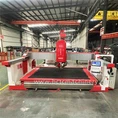


Can a 5 Axis Bridge Saw cut metal materials?
As a supplier of 5 Axis Bridge Saws, I often get asked the question: Can a 5 Axis Bridge Saw cut metal materials? This is a valid query, especially considering the versatility and precision that these machines are known for. In this blog post, we'll delve into the capabilities of 5 Axis Bridge Saws when it comes to cutting metal, exploring the technical aspects, limitations, and potential applications.
Understanding the 5 Axis Bridge Saw
Before we discuss whether a 5 Axis Bridge Saw can cut metal, let's first understand what a 5 Axis Bridge Saw is. A 5 Axis Bridge Saw is a highly advanced cutting machine that offers five degrees of freedom in movement. This means that it can move in three linear directions (X, Y, and Z) and rotate around two additional axes (A and C). This multi - axis movement allows for complex and precise cuts on various materials, making it a popular choice in industries such as stone processing.
The Cutting Mechanism of a 5 Axis Bridge Saw
The cutting mechanism of a 5 Axis Bridge Saw typically involves a diamond blade. Diamond is one of the hardest materials on Earth, and diamond - tipped blades are extremely effective at cutting through hard materials. In the case of stone cutting, the diamond blade grinds and chips away at the stone to create the desired cut.
When it comes to metal cutting, the cutting process is different. Metals have different physical properties compared to stones. Metals are generally more ductile and have a higher melting point. The traditional diamond - blade cutting method used in stone processing may not be as effective for metal cutting.
Can a 5 Axis Bridge Saw Cut Metal?
The short answer is: it depends. While a 5 Axis Bridge Saw is primarily designed for cutting stone materials, some models can be adapted to cut certain types of metal under specific conditions.
Feasibility for Soft Metals
Soft metals such as aluminum and copper can potentially be cut by a 5 Axis Bridge Saw. These metals are relatively easy to cut compared to harder metals like steel. The diamond blade can grind through the soft metal, but it's important to note that the cutting speed and feed rate need to be carefully adjusted. A slower cutting speed and a lower feed rate are usually required to ensure a clean and precise cut.
Challenges with Hard Metals
Hard metals like steel pose a significant challenge for a 5 Axis Bridge Saw. The hardness of steel is much higher than that of stone, and the diamond blade may not be able to cut through it effectively. Additionally, the high heat generated during the cutting process can cause the diamond blade to wear out quickly. To cut hard metals, a different type of cutting tool, such as a carbide - tipped blade or a plasma cutter, is usually more suitable.
Potential Applications of 5 Axis Bridge Saw in Metal Cutting
Even though the use of a 5 Axis Bridge Saw for metal cutting is limited, there are still some potential applications:
Prototyping
In the prototyping stage, a 5 Axis Bridge Saw can be used to create simple metal parts with complex shapes. For example, in the automotive or aerospace industries, where rapid prototyping is crucial, a 5 Axis Bridge Saw can be used to quickly produce small - scale metal prototypes.
Custom Metalwork
For custom metalwork projects, a 5 Axis Bridge Saw can be used to create unique and intricate designs. This is especially useful for artists and designers who want to incorporate metal elements into their work.


Limitations and Considerations
When considering using a 5 Axis Bridge Saw for metal cutting, there are several limitations and considerations to keep in mind:
Blade Wear
As mentioned earlier, the diamond blade may wear out quickly when cutting metal, especially hard metals. This can increase the cost of operation as the blade needs to be replaced more frequently.
Cutting Speed and Precision
The cutting speed of a 5 Axis Bridge Saw may be slower when cutting metal compared to stone. Additionally, achieving high precision in metal cutting may be more challenging due to the different physical properties of metals.
Safety
Metal cutting can generate a lot of heat and debris. Proper safety measures need to be in place to protect the operator and the machine. This includes using appropriate personal protective equipment and having a good ventilation system.
Conclusion
In conclusion, while a 5 Axis Bridge Saw is primarily designed for stone cutting, it can be used to cut certain types of soft metals under specific conditions. However, for hard metals, other cutting methods are usually more suitable. If you are interested in exploring the possibility of using a 5 Axis Bridge Saw for metal cutting, it's important to consult with a professional to determine the best approach.
As a supplier of 5 Axis Bridge Saws, we offer a range of high - quality machines that are suitable for various applications. If you are in the market for a Stone Slab Cutting Machine, Bridge Saw Machine Granite, or Stone Cutting Machine, we are here to assist you. Whether you need a machine for stone cutting or are interested in exploring metal cutting capabilities, our team of experts can provide you with the right solutions. Contact us today to start a discussion about your specific requirements and to explore the potential of our 5 Axis Bridge Saws.
References
- Smith, J. (2020). Advanced Cutting Technologies. Publisher: Tech Press.
- Johnson, A. (2019). Materials and Cutting Processes. Publisher: Industrial Books.